
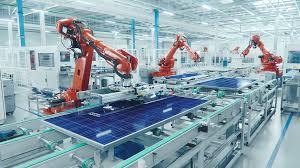

The industrial automation landscape in 2025 is undergoing a profound transformation, driven by cutting-edge technologies and innovative methodologies. This article delves into the advanced trends shaping the future of manufacturing, focusing on AI-driven robotics, sustainable practices, and the integration of smart systems.
AI-Driven Robotics: The Vanguard of Smart Manufacturing
Humanoid Robots in Industrial Settings
In 2025, humanoid robots are making significant inroads into manufacturing environments. Foxconn’s new AI server manufacturing plant in Houston exemplifies this shift, where humanoid robots powered by Nvidia’s Isaac GR00T N platform are set to revolutionize production lines. These robots are designed to perform complex tasks with precision, enhancing efficiency and reducing human error.
Collaborative Robots (Cobots): Enhancing Human-Robot Interaction
Collaborative robots, or cobots, are increasingly being integrated into production lines. Unlike traditional industrial robots that operate in isolation, cobots work alongside human operators, sharing tasks and adapting to dynamic environments. This synergy not only improves productivity but also ensures a safer working environment.
Agentic AI: Transforming Industrial Automation
Agentic AI represents a paradigm shift in industrial automation. By enabling machines to understand and execute tasks based on high-level human intentions, agentic AI simplifies complex processes. This approach allows for more intuitive human-machine interactions and enhances the adaptability of manufacturing systems.
Sustainable Manufacturing Practices: A Commitment to the Environment
Adoption of Green Technologies
Manufacturers are increasingly adopting green technologies to minimize environmental impact. This includes the use of renewable energy sources, energy-efficient machinery, and sustainable materials. For instance, Lego’s new factory in Vietnam is set to operate entirely on clean energy by early 2026, reflecting a broader industry trend towards sustainability.
Circular Economy Models
The implementation of circular economy principles is gaining momentum in the manufacturing sector. This model emphasizes the reuse and recycling of materials, reducing waste and conserving resources. Companies are designing products with end-of-life considerations in mind, facilitating easier disassembly and recycling.
Sustainable Supply Chain Management
Sustainable practices are extending beyond the factory floor into supply chains. Manufacturers are collaborating with suppliers to ensure ethical sourcing of materials and to reduce the carbon footprint of transportation. This holistic approach to sustainability is becoming a competitive differentiator in the market.
Smart Systems Integration: The Backbone of Industry 4.0
Industrial Internet of Things (IIoT)
The IIoT is a cornerstone of Industry 4.0, connecting machines, sensors, and systems to collect and analyze data in real-time. This connectivity enables predictive maintenance, optimized production schedules, and enhanced quality control, leading to increased operational efficiency.
Digital Twins and Simulation
Digital twins—virtual replicas of physical assets—allow manufacturers to simulate and monitor production processes. This technology facilitates proactive problem-solving, reduces downtime, and supports continuous improvement initiatives.
Edge Computing and Cloud Integration
The combination of edge computing and cloud technologies enables manufacturers to process data locally for immediate decision-making while leveraging cloud resources for comprehensive analytics and long-term planning. This hybrid approach balances speed and scalability in industrial operations.
Workforce Transformation: Adapting to Technological Advancements
Upskilling and Reskilling Initiatives
As automation technologies evolve, there is a growing need for a skilled workforce capable of operating and maintaining advanced systems. Companies are investing in upskilling and reskilling programs to equip employees with the necessary competencies, ensuring they can thrive in a technology-driven environment.
Human-Centric Automation
Human-centric automation focuses on enhancing human capabilities through technology. Rather than replacing workers, this approach aims to augment their skills, enabling them to perform more complex and value-added tasks. This philosophy fosters a collaborative relationship between humans and machines.
Ethical Considerations in Automation
The rapid advancement of automation raises ethical questions regarding job displacement and data privacy. Manufacturers are addressing these concerns by implementing transparent policies, ensuring data security, and creating pathways for employees to transition into new roles within the organization.
Future Outlook: The Road Ahead for Industrial Automation
Looking forward, the industrial automation sector is poised for continued growth and innovation. Advancements in AI, robotics, and sustainable practices are expected to drive efficiencies and open new avenues for product development. However, challenges such as cybersecurity threats, regulatory compliance, and the need for skilled labor will require ongoing attention and adaptation.
Frequently Asked Questions (FAQs)
1. What are humanoid robots, and how are they used in manufacturing?
Humanoid robots are machines designed to perform tasks that typically require human intervention. In manufacturing, they are utilized for complex assembly processes, quality inspections, and material handling, enhancing efficiency and precision.
2. How does agentic AI differ from traditional automation systems?
Agentic AI systems interpret high-level human intentions and autonomously execute tasks, offering greater flexibility and adaptability compared to traditional automation, which relies on predefined instructions.
3. What is a digital twin, and what role does it play in manufacturing?
A digital twin is a virtual model of a physical asset or system. In manufacturing, it allows for real-time monitoring and simulation of production processes, aiding in predictive maintenance and process optimization.
4. How are companies addressing the environmental impact of manufacturing?
Companies are implementing sustainable practices such as using renewable energy, adopting circular economy models, and optimizing supply chains to reduce their environmental footprint.
5. What is the significance of IIoT in modern manufacturing?
The Industrial Internet of Things (IIoT) connects machines and systems to collect and analyze data, enabling real-time decision-making, predictive maintenance, and improved operational efficiency.
6. How is the workforce adapting to advancements in automation?
Workforce adaptation involves upskilling and reskilling programs, focusing on human-centric automation, and addressing ethical considerations to ensure employees can thrive alongside technological advancements.
7. What challenges does the industrial automation sector face moving forward?
Challenges include cybersecurity threats, regulatory compliance, and the need for a skilled workforce, all of which require ongoing attention to ensure sustainable growth in the sector.

Comments are closed.