
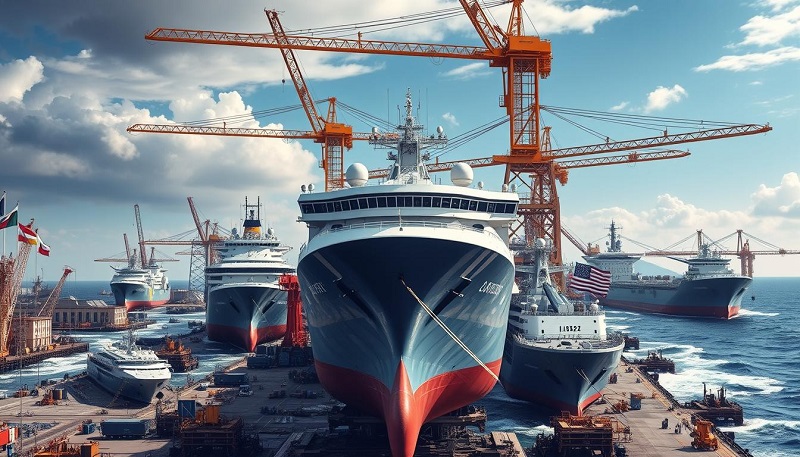

Global shipping is navigating its most consequential structural transition in over a century. Driven by aggressive international decarbonization mandates, volatile energy markets, and shifting supply chains, the maritime industry can no longer rely on legacy fabrication workflows. Traditional shipbuilding—long characterized by labor-heavy manual welding, conservative naval architecture, and rigid build schedules—is rapidly giving way to an era of digital manufacturing and precision automation. Modern shipyards increasingly resemble aerospace facilities rather than the brute-force steel yards of the twentieth century. From high-fidelity digital twins and robotic welding gantries to modular alternative-fuel architectures, new industrial technologies are rewriting how commercial and naval vessels are conceptualized, assembled, and sustained across their operating lifecycles.
Digital Twins and Predictive Naval Architecture
The modern build cycle now begins entirely in virtual space long before a single plate of marine-grade steel is cut. High-fidelity digital twins have moved beyond theoretical modeling to become the central nervous system of contemporary vessel design. Naval architects use comprehensive Product Lifecycle Management (PLM) software to build dynamic, physics-based simulations that capture structural stress, thermodynamic behavior, and hydrodynamics in real time.
By running complex Computational Fluid Dynamics (CFD) algorithms against a virtual hull form, engineers can test thousands of hull variations under simulated sea states. This iterative virtual testing identifies drag penalties, cavitation risks, and structural stress concentrations that physical scale-model towing tanks might fail to expose.
Crucially, the digital twin does not retire once construction begins. The exact numerical model that governs shipyard cutting machines translates directly into an operational asset for vessel owners. Throughout the vessel’s operational life, onboard sensor packages feed performance telemetry back into the model, allowing operators to monitor structural fatigue, forecast machinery maintenance, and optimize trim based on real-world sailing data.
Robotic Automation and High-Precision Fabrication
Fabrication floors are undergoing a quiet industrial overhaul centered on robotics and high-tolerance modular assembly. Constructing a modern mega-vessel requires joining hundreds of thousands of steel plates into self-contained building blocks, which are subsequently outfitter-equipped and welded together in dry dock. Historically, the dimensional variations inherent in manual cutting and welding created fit-up errors that demanded costly rework.
Shipyards are countering this through robotic welding gantries and laser-hybrid welding (LHW). Unlike conventional submerged arc welding, laser-hybrid systems combine a focused laser beam with a traditional electric arc. The result is a dramatically narrower heat-affected zone, deeper penetration in a single pass, and minimal thermal distortion of the steel panels. Because thin bulkhead plates remain flat rather than warping under excessive heat, yards bypass the labor-intensive thermal straightening processes that traditionally slowed hull assembly lines.
Furthermore, three-dimensional optical metrology and handheld LIDAR scanners now verify module dimensions in real time. If an 800-ton deck block deviates from its engineering tolerances by even a few millimeters, automated alignment systems flag the discrepancy immediately, ensuring that blocks mate seamlessly in the building dock with zero field adjustments.
Additive Manufacturing for Complex Marine Hardware
Additive manufacturing, or industrial 3D printing, is transitioning from rapid prototyping into the production of critical end-use marine components. Marine hardware must endure punishing, corrosive saltwater environments, which historically required casting or forging expensive alloys with lead times stretching across months.
Through Wire Arc Additive Manufacturing (WAAM) and direct metal laser sintering, yards and component suppliers can now print complex metallic structures on demand. WAAM is particularly effective for large-scale geometries, including customized propeller blades, rudder stock brackets, and intricate sea-chest valves. By depositing weld bead layer by layer using robotic arms, manufacturers can produce near-net-shape components using specialized nickel-aluminum bronze or duplex stainless steel while cutting raw material scrap by up to 70 percent.
Beyond primary construction, additive techniques unlock generative design. Engineers can strip redundant mass from structural nodes, creating hollow or latticed interior geometries that maintain structural yield strength while shedding significant weight above the waterline. This weight optimization translates directly into higher cargo capacity and lowered fuel burn over the lifespan of the ship.
Designing for Decarbonization: Clean Propulsion and Modular Keels
Stringent emissions standards set by the International Maritime Organization (IMO) require vessels to cut greenhouse gas output radically, creating a design puzzle for yards building ships meant to operate for thirty years. Because the winning green fuel of the 2030s and 2040s—whether green methanol, liquified biomethane, ammonia, or fuel-cell hydrogen—remains a moving target, modern shipbuilders are pioneering modular, future-proof hull engineering.
Yards are building ships around modular propulsion bays that allow main engines and auxiliary machinery to be swapped or retrofitted with minimal structural disruption. Piping corridors, exhaust runs, and fuel storage footprints are engineered from the outset to accommodate cryogenic tanks or toxic-gas mitigation systems, allowing owners to order dual-fuel-ready ships that can be converted affordably during routine drydocking.
At the same time, yards are integrating hull-level energy-saving devices directly into the keel architecture:
-
Micro-bubble air lubrication systems: Dedicated air compressors pump microscopic air bubbles along the bottom of the hull, creating a fluid cushion that substantially reduces skin friction against seawater.
-
Integrated wind-assist foundations: Structural reinforcements and electrical routing are embedded directly into weather decks during initial fabrication, facilitating the plug-and-play installation of rigid wing sails or Flettner rotors.
-
Asymmetric stern and rudder bulbs: Custom hydrodynamic profiles channel propeller wash efficiently, recovering lost rotational energy and generating forward thrust.
The Connected Shipyard: Industrial IoT and Predictive Quality Assurance
Hardware innovations deliver their greatest value when tied together by data. Leading global shipyards are implementing Industrial Internet of Things (IIoT) platforms that connect material staging areas, overhead cranes, cutting tables, and dry docks into a synchronized network.
RFID-tagged steel plates and structural components communicate their location automatically, preventing the logistics bottlenecks that frequently stall final assembly. On the quality assurance side, deep-learning computer vision models evaluate radiographic and ultrasonic test results from structural welds, catching internal voids or micro-cracks instantly and with greater consistency than human inspectors can manage alone. This end-to-end transparency drives down lead times, lowers warranty claims, and preserves construction margins in an intensely competitive global market.
The convergence of predictive digital architecture, automated factory production, and flexible green engineering marks a decisive break from maritime manufacturing traditions. Shipbuilders that master these interlinked technologies are doing more than building vessels faster; they are producing a lighter, smarter, and cleaner global fleet capable of meeting the economic and environmental imperatives of the coming decades.

Comments are closed.